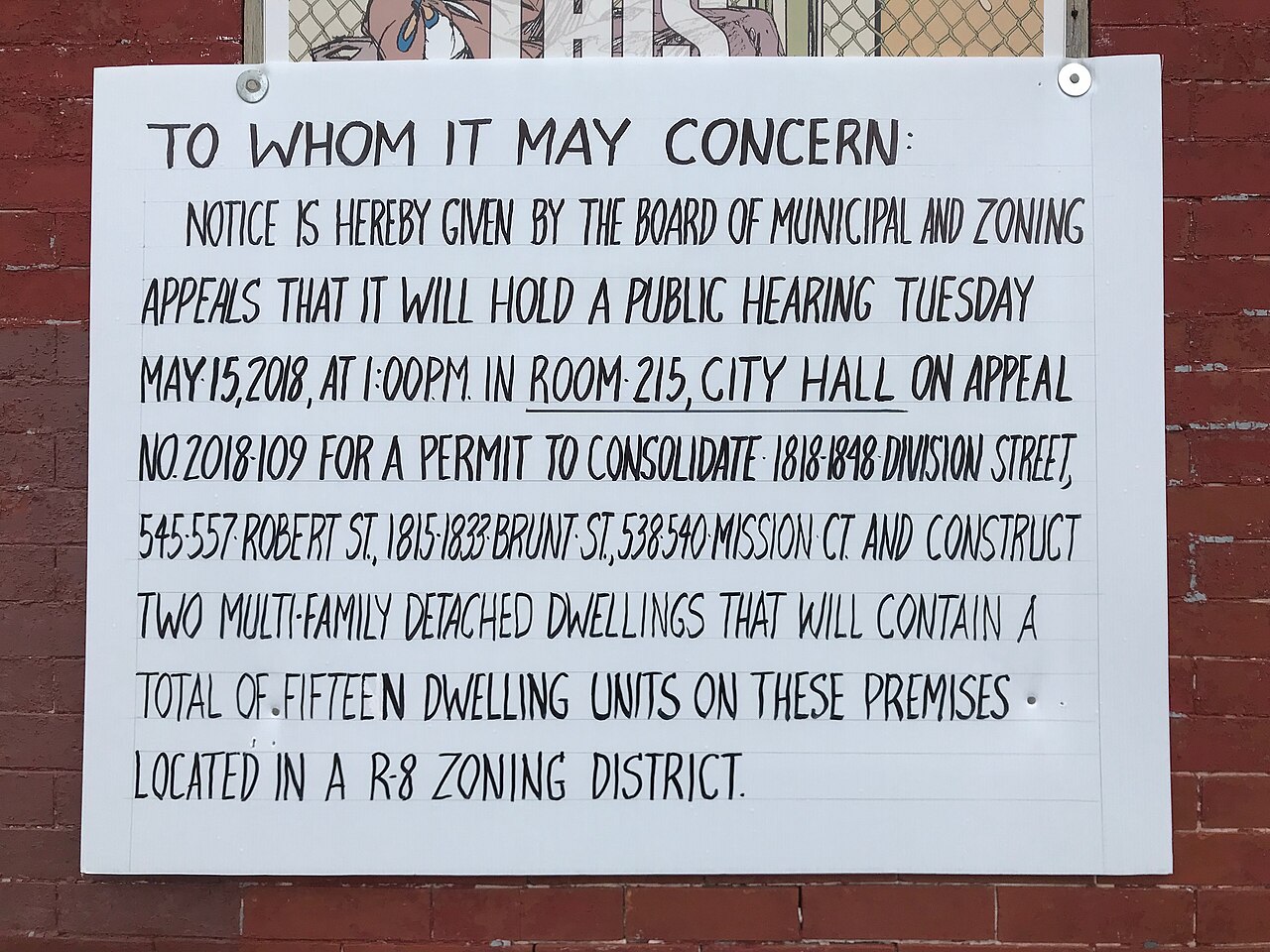
It arrives looking like junk mail: a plain envelope from the City of Dallas with a map, a case number that starts with Z, and a form asking whether you support or oppose something you’ve never heard of. Maybe you’ve also noticed a yellow sign staked into the lot around the corner. Somebody wants to change what can legally be built near your house, and the city is required to tell you and ask what you think.
That notice is not a formality, and it’s not a done deal. Here’s what the letter actually means, how to find out what’s really proposed, and how the process gives nearby homeowners more leverage than most of them ever use.
Why you got the letter
Dallas mails written notice of a zoning-change hearing to the owners of all property within 200 feet of the land in question (what the code calls the “area of request”) at least 10 days before the City Plan Commission hears the case. The requirement comes from the city’s development code, Section 51A-4.701 of the Dallas City Code, which lays out the whole amendment process. The applicant also has to post notice signs on the property itself, which is what that yellow sign on the lot is doing.
Getting the letter means one thing: the city’s official records say you own property within 200 feet, so you have a formal role in the case if you want one. The enclosed reply form (support or oppose, with a signature) is not a survey for decoration. As you’ll see below, those forms can change the math of the final vote.
What a zoning change can actually do
The request might be small (a restaurant wanting a parking variance’s cousin, a specific use permit for a daycare) or large (rezoning a block of single-family lots for a multi-story mixed-use building). The notice will name the current zoning, the requested zoning, and the case number. The shorthand matters: a “PD” is a planned development district with its own custom rules; an “SUP” is a specific use permit that allows one particular use, often with conditions and a time limit.
To see the full file (site plans, staff analysis, hearing dates), start with the Planning and Development Department’s current planning page, which tracks pending zoning cases, and the hearing agendas posted on the City Secretary’s public meetings page. Every notice also lists the case planner’s name and phone number. Call them. It’s their job to explain the request in plain English, and they’ll tell you things the map can’t, like whether the applicant has already scaled the project back.
The road every case travels
A Dallas zoning case moves through two public hearings. First, the City Plan Commission (appointed residents, one per council district plus the mayor’s appointee) hears the case, takes public comment, and votes on a recommendation. Then the case goes to the City Council for a second public hearing and the binding vote. You can speak at both, and you don’t have to be a lawyer or bring a slideshow; two minutes of “I live 100 feet away and here is what this does to my street” is exactly what the process is built to hear.
Cases routinely get delayed, revised or negotiated between those two hearings. Deed restrictions get volunteered, buildings get shorter, driveways get moved. If neighbors show up organized and specific, they are often the reason why.
The 20 percent rule: when opposition forces a supermajority
Here’s the leverage most recipients never learn about. Under state law (Section 211.006 of the Texas Local Government Code), if the owners of at least 20 percent of the land within the area of request, or 20 percent of the land within 200 feet of it, file a written protest against the change, the rezoning can’t pass on a simple majority. It takes an affirmative vote of three-fourths of all City Council members. On Dallas’s 15-member council, that means 12 votes instead of 8.
This is why the reply form in your envelope matters. Signed opposition forms from enough nearby land can flip a case from “comfortable approval” to “needs near-unanimity.” Note the measure is land area, not headcount: one neighbor with a big lot can carry more protest weight than five townhomes. If your street is genuinely opposed, coordinate: forms need to be filed with the city before the council acts, and the earlier they’re in, the more they shape the negotiation.
If you support it, that’s a role too
Not every notice is a threat. Maybe the change replaces a vacant eyesore, or brings the corner store your block has wanted for a decade. Support works the same way in reverse: send the form back marked in favor, speak at the hearings, and say so to your council member’s office. Commissioners consistently say they hear from opponents ten times more often than supporters, so a few voices in favor carry real weight.
The short version
Don’t toss the envelope. Read the case number, look it up or call the planner, and send the reply form back either way. Show up (or write in) for the Plan Commission hearing, then the council one. And if you’re within 200 feet and opposed, remember the 20 percent rule. It’s the difference between being background noise and holding a lever that state law built specifically for you.
This article was produced with AI assistance and reviewed by a human editor. Figures are linked to their primary sources; where a claim could not be verified from the public record, we say so.

Leave a Reply